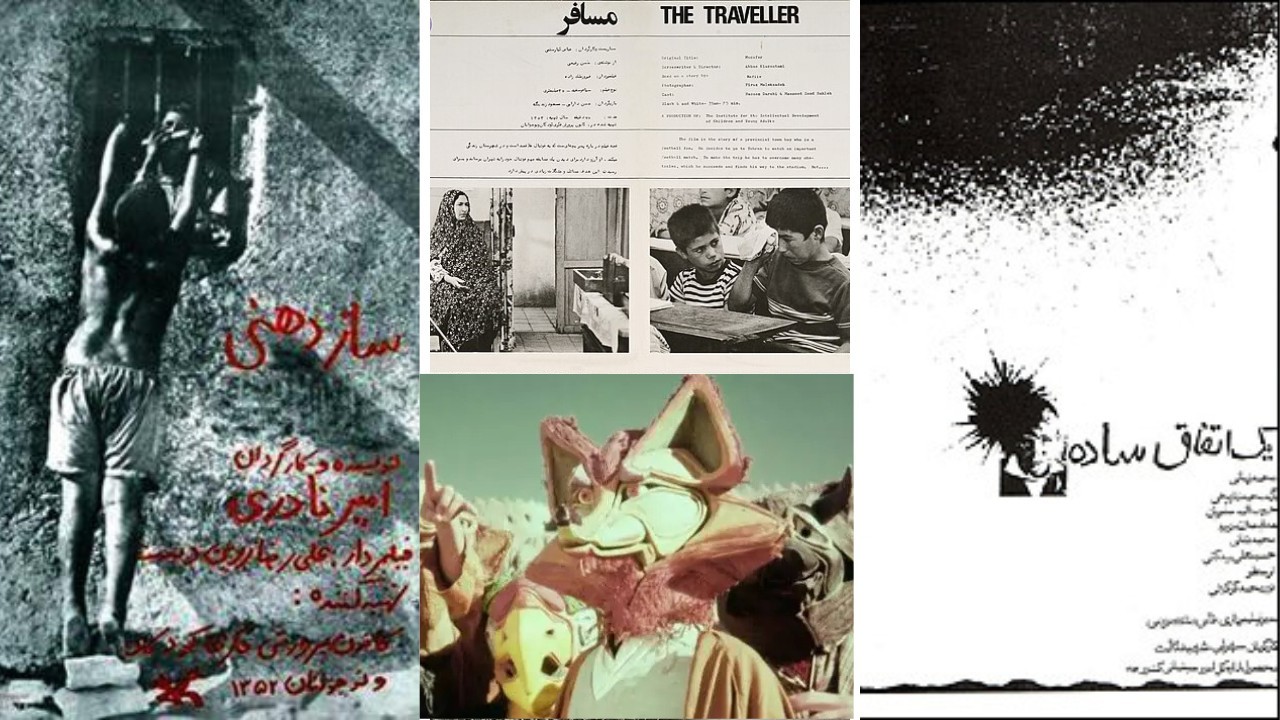
The roots of intellectual children’s cinema in Iran date back to the 1960s and 70s—a golden era where the IIDCYA (Kanoon) became a sanctuary for avant-garde filmmakers. In this Seven Skies exclusive, we revisit four pillars of pre-revolution Iranian cinema that shaped the nation’s artistic identity.
1. Harmonica & The Traveler: Tales of Struggle and Passion
In 1973, Amir Naderi directed “Harmonica” (Saz-Dahani), a powerful cinematic metaphor for power and exploitation. The story of Amiro, a boy who endures humiliation just to play a musical instrument, remains a profound critique of tyranny. Meanwhile, Abbas Kiarostami took his camera to the streets in “The Traveler” (Mosafer). By capturing a young boy’s obsessive passion for football and the Persepolis club, Kiarostami avoided commercial clichés to tell a raw, human story that still resonates with Iranian youth today.
2. Neo-Realism and the Brilliance of “A Simple Event”
Sohrab Shahid Saless opened a new window in Iranian cinema with “A Simple Event.” His minimalist portrayal of a student caught between poverty and education offered a stark contrast to the “Filmfarsi” commercial trends of the time. This masterpiece established a new wave of realism that influenced generations of filmmakers. Alongside these features, the era was defined by groundbreaking animators like Noureddin Zarrinkelk and Morteza Momayyez, who elevated Iranian animation to global festival standards.
3. Shahr-e Qesseh: Folklore Meets Modernity
Based on the play by Bijan Mofid and directed by Manouchehr Anvar, “Shahr-e Qesseh” (City of Tales) was a landmark cultural event. Using animal masks and traditional folklore, this allegorical work challenged the tensions between tradition and modernity. With its iconic characters like the Fox, the Elephant, and the Donkey, it managed to entertain children while providing deep social commentary for adults—a legacy preserved today in the Museum of Childhood Culture.
Pre-revolution children’s cinema was more than just entertainment; it was a universal language that spoke of profound human and social truths through the eyes of a child.